Labiaplasty with Twilight Sedation
Thanks for coming to my labiaplasty blog to learn more about today’s patient! She is a 35-year-old mom of two who primarily was bothered by the thickness of her labia minora and especially the prominence of her clitoral hood. She had trouble wearing clothing because she felt that her labia looked too full in her bikini bottoms and yoga pants. She stated that over time she has developed increased thickening and discomfort of the labia minora and so she was really excited to have a labiaplasty performed with me today.
She opted for an IV sedation labiaplasty (aka twilight sedation) so that she wouldn’t be bothered by the local anesthesia injections. About 95% of my patients have the procedure under local anesthetic but I am always ready with my anesthetist to help make patients more comfortable during their labiaplasty surgery.
As you can see from her before picture, she had more thickening than length. Both the clitoral hood and labia minora tissues had more thickness than is typical. Of course, each patient has a different shape to the labia minora and clitoral hood, some women have differential enlargement of the hood. Therefore, it’s important to perform both a labiaplasty and a hood reduction in many cases. If only a labiaplasty is performed the clitoral hood tissues (sometimes called the prepuce) can be too prominent leading to imbalance, and this can lead to a “puffy” and full appearance at the top of the vulva. That fullness can cause a widening of the vaginal cleft which is also suboptimal for the ideal aesthetic vaginal appearance in patients seeking labiaplasty surgery.
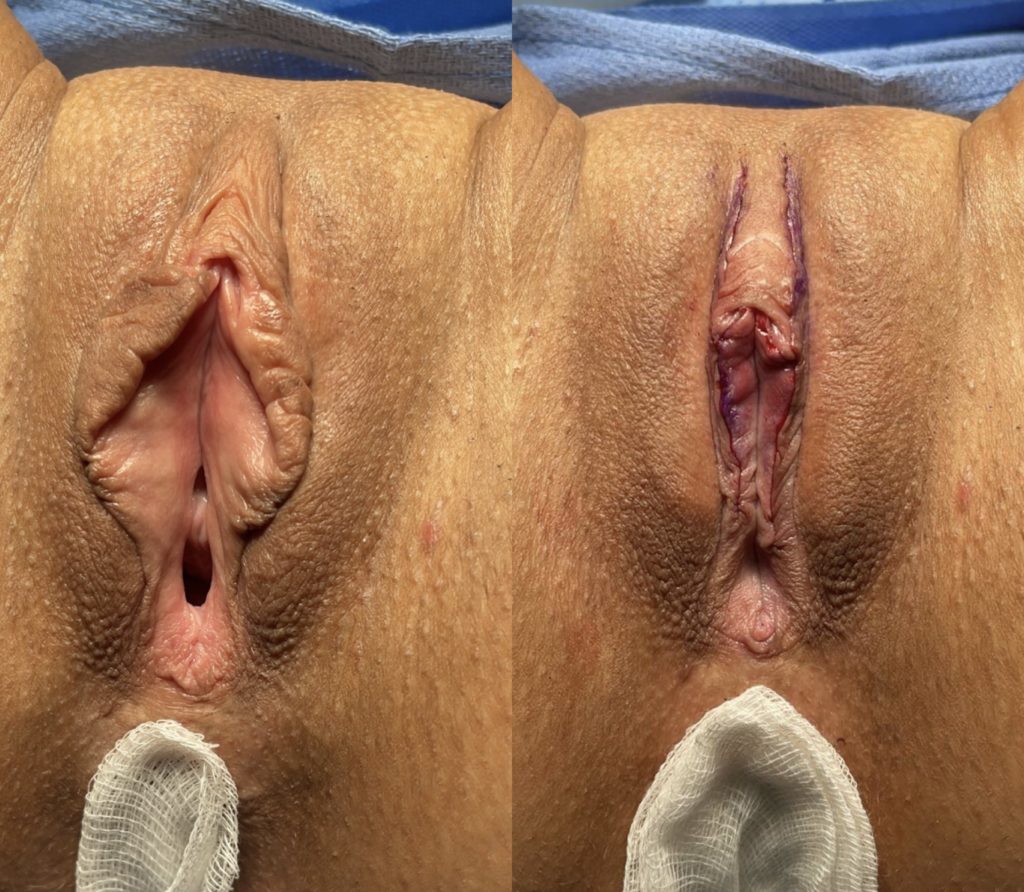
I am overall very happy with the outcome of this Labiaplasty which was really one part reducing the length of the hood and labia minora and one part debulking (or thinning out) the hood and labia minora.
I think the thing that is most fascinating to me about labiaplasty surgery is that no two labia are alike. I think that this creates a complex puzzle that can be optimized for each patient if the right amount of care, attention and dedication is put forth into labiaplasty surgery. Thanks again for joining me here and for supporting my patients in their journey to self-confidence through labiaplasty.