Labiaplasty in Your 40s: Thirty Years in the Making
A 44-year-old patient finally addressed concerns she had carried for 30 years. Her case involved a hood reduction, labiaplasty, and perineoplasty with a J-shaped pattern — a reminder that beautiful results are achievable at any age.
Case Story
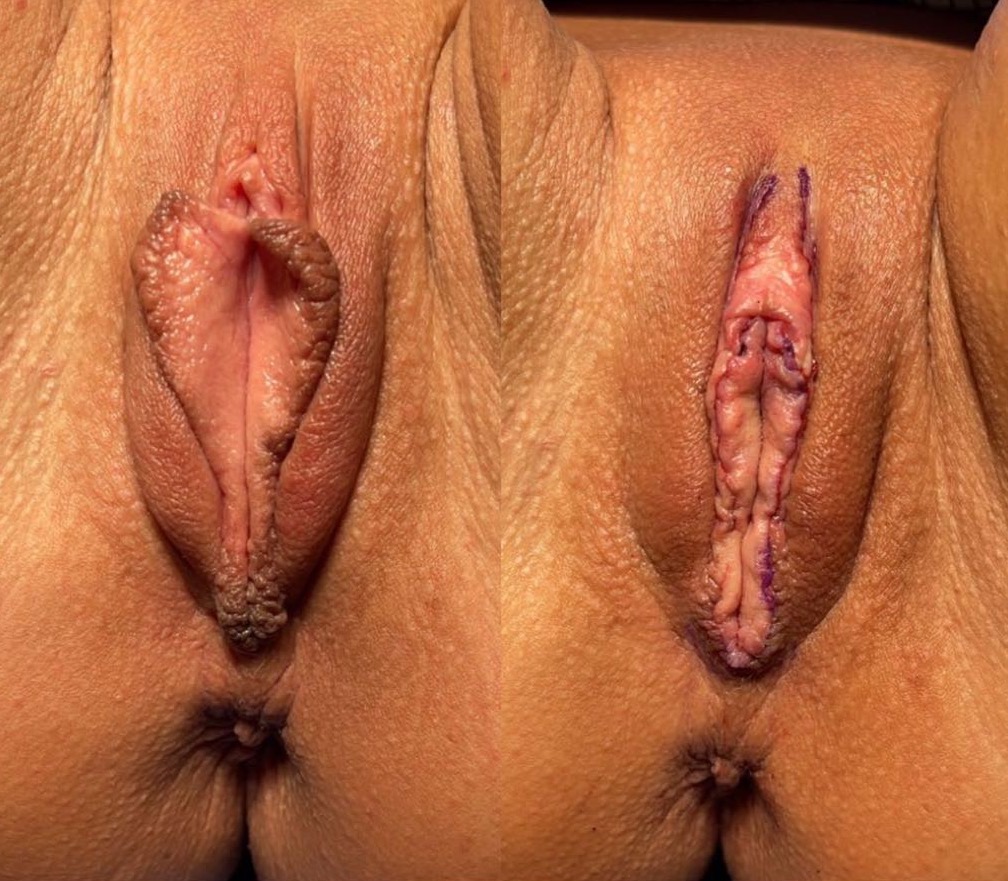
Today’s patient is a 44-year-old woman who came to me with a 30-year history of being bothered by her labia. While she was understandably nervous, she was also deeply excited to finally move forward. At her age and with her history, this was a long time coming — and I was honored to be the surgeon she chose.
The most important principle in labiaplasty is balance and symmetry: removing the right amount of tissue from the top, the middle, and the bottom of the vulva. In her case, she had excess perineal tissue, a slightly longer and more prominent labia minora on her left side, and excess clitoral hood tissue. For this reason, we performed a hood reduction, a labiaplasty, and a perineoplasty using a J-shaped excision pattern.
Every labiaplasty case is different, and hers required a very precise, multi-area approach. Her procedure went beautifully. I am confident this will bring her significant symptom relief and correct the discomfort she has lived with for three decades.
Multi-area procedure for full balance and symmetry
Performed under local anesthesia
Resolved 30 years of physical discomfort and self-consciousness
Surgical Philosophy and Teaching Points
Every Labiaplasty Is Customized to the Patient's Anatomy
No two labiaplasty cases are the same. Each patient presents with a different configuration of excess tissue, asymmetry, and proportional concerns. In this patient’s case, the procedure spanned three areas — hood, labia minora, and perineum — each requiring a different technique and a different amount of tissue removal. This kind of individualized approach is what produces results that look and feel natural.
The J-Pattern Perineoplasty
When perineal tissue needs to be addressed along with the labia and hood, Dr. Oppenheimer sometimes uses a J-shaped excision pattern to remove excess skin from the lower portion of the vulva. This approach allows for efficient, well-contoured tissue removal that integrates naturally with the rest of the procedure.
There Is No Wrong Age for Labiaplasty
Many women wait years — sometimes decades — before seeking care. Age alone is not a contraindication to labiaplasty. Healing in the 40s is different from healing at 20, but it is absolutely achievable, and the emotional relief of addressing a long-standing concern can be profound at any stage of life.
Frequently Asked Questions
Can women in their 40s have labiaplasty?
Yes. Labiaplasty is performed safely across a wide age range. While healing may be slightly slower with age, the results are excellent. This patient's case — resolved after 30 years — is a strong example of what is possible.
What is a perineoplasty with a J-shaped pattern?
A J-shaped perineoplasty removes excess perineal skin in a J-contoured pattern, allowing Dr. Oppenheimer to address tissue that extends into both the perineum and the lower labia minora region. It is used when standard excisions would not adequately address the full area of concern.
What causes asymmetry in the labia minora?
Labia asymmetry is a normal anatomical variation. One side is often slightly larger or longer than the other. Hormonal changes, aging, and genetics all influence labial size and shape over time. Asymmetry that causes discomfort or self-consciousness is correctable through labiaplasty.
How is a hood reduction performed at the same time as labiaplasty?
Hood reduction and labiaplasty are performed sequentially in the same session, usually starting with the hood and then moving to the labia minora. Together they take approximately 60 to 90 minutes and heal in the same recovery period.
Is it too late to have labiaplasty after living with the concern for decades?
No. There is no deadline for seeking relief. Many patients who have delayed for years describe the decision as one of the most positive they have made for their quality of life and confidence.