Labiaplasty for a Young Mom: Reclaiming Your Body After Childbirth
A 28-year-old mother came to Dr. Oppenheimer bothered by thick, discolored labial edges and a prominent hood. Her procedure included IV sedation and documented the reality of postpartum anatomy — perineal scarring and minor hemorrhoids — with candor and respect.
Case Story
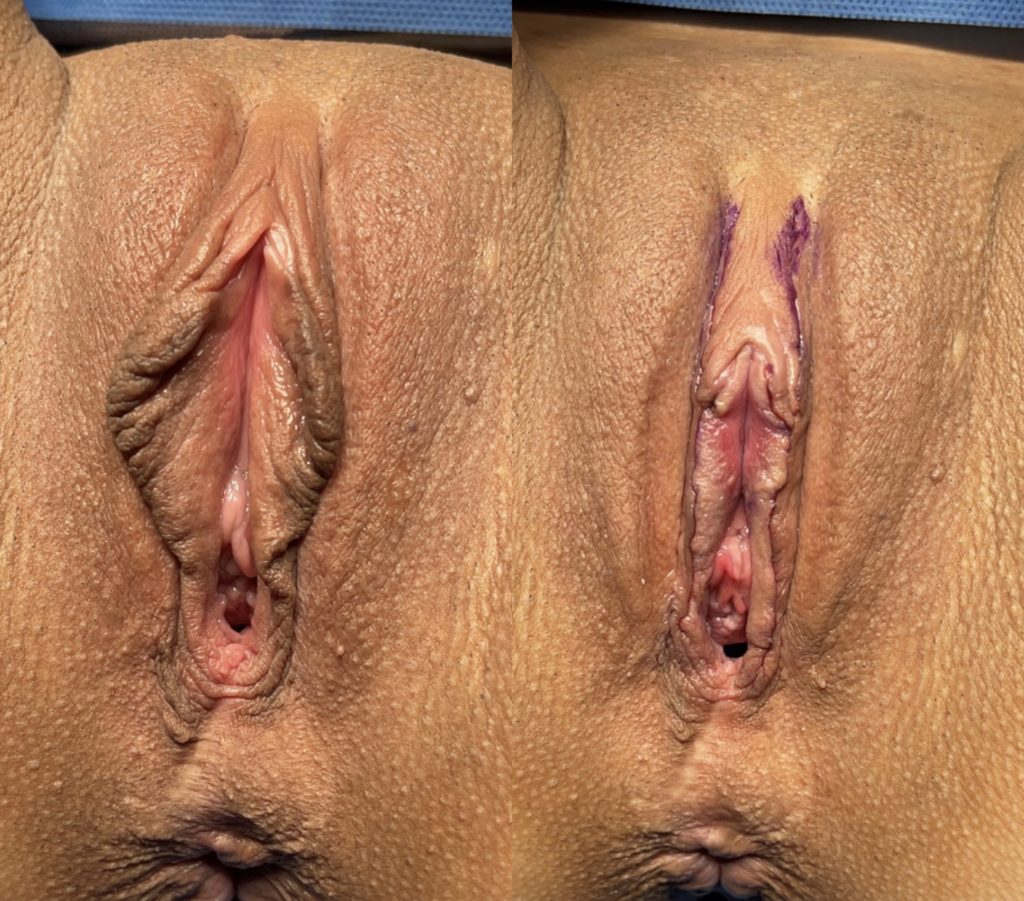
Today’s patient is 28 years old. She was primarily bothered by the thick, discolored edge of her labia minora and the prominence of her clitoral hood, which created fullness at the top of the vulva that bothered her. She had reviewed my before-and-after galleries and watched many of my videos before choosing to have surgery with me — something I always find humbling.
She was a little nervous beforehand, so we opted for IV sedation with my CRNA, which allowed her to be completely comfortable and asleep throughout the procedure. We began with the hood reduction, addressing the more prominent clitoral hood first, then proceeded to the labia minora reduction to smooth and lighten the labial edge.
I have so much respect for what women’s bodies go through during pregnancy and childbirth. In examining her, I noted a perineal tear scar from her vaginal delivery — a slightly diagonal scar heading toward the anal sphincter — as well as minor hemorrhoids that were not significant enough to require treatment. Helping women like her reclaim their bodies through thoughtful, respectful surgery is one of the most meaningful parts of my practice.
Post-procedure result
Procedure Highlights
Labia minora reduction for thick, discolored edge
Clitoral hood reduction for upper fullness
Performed under IV sedation for patient comfort
Postpartum anatomy respectfully documented
Perineal tear scar from vaginal delivery noted
Minor hemorrhoids present but not treated
Surgical Philosophy and Teaching Points
Postpartum Anatomy Is Complex — and Deserves Honest Assessment
Childbirth changes the body in ways that are not always discussed openly. Perineal tears, scarring, and minor hemorrhoids are common sequelae of vaginal delivery that many women live with quietly. Acknowledging what is there — and distinguishing what warrants treatment from what does not — is part of a thorough surgical consultation and a respectful approach to the patient’s body.
IV Sedation for the Nervous Patient
For patients who experience significant anxiety about procedures, IV sedation with a CRNA provides complete comfort — the patient is asleep, has no memory of the procedure, and feels no pain. It adds minimal complexity to the surgery while making a significant difference for the patient’s experience. Most of the time local anesthesia alone is sufficient, but sedation is always available.
Thick, Discolored Edges Are Exactly What the Edge Technique Removes
The outer border of the labia minora tends to be the thickest and most discolored. The edge technique labiaplasty removes precisely this border, leaving behind inner labial tissue that is smoother, softer, and more naturally pigmented. For patients like this one whose primary concern is the texture and color of the edge, the edge technique delivers the most targeted improvement.
Frequently Asked Questions
Can I have a labiaplasty after a vaginal delivery?
Yes. Labiaplasty is commonly performed after childbirth. Most surgeons recommend waiting until at least six months postpartum to allow tissues to fully recover. Vaginal delivery does not complicate the procedure when healing from the birth is complete.
What happens to the perineum during vaginal delivery?
Many women experience perineal tears or episiotomies during vaginal delivery. These heal over time but can leave visible scarring. In some cases, a perineoplasty can address residual perineal tissue changes if they are bothersome.
What is IV sedation and is it safe for labiaplasty?
IV sedation, also called twilight sedation, uses intravenous medication to put the patient into a relaxed, sleep-like state for the duration of the procedure. It is safe, well-tolerated, and performed with a CRNA present throughout.
Will labiaplasty help with thick or discolored labial edges?
Yes. The edge technique removes the thickest, most discolored outer edge of the labia minora and reveals smoother, more naturally pigmented tissue. For patients whose primary concern is texture or color, this is one of the most effective ways to address it.
Do I need to treat hemorrhoids before labiaplasty?
Minor hemorrhoids do not need to be treated before labiaplasty. They are a separate issue that does not affect the labiaplasty procedure. Significant hemorrhoids that are symptomatic would be referred to the appropriate specialist first.