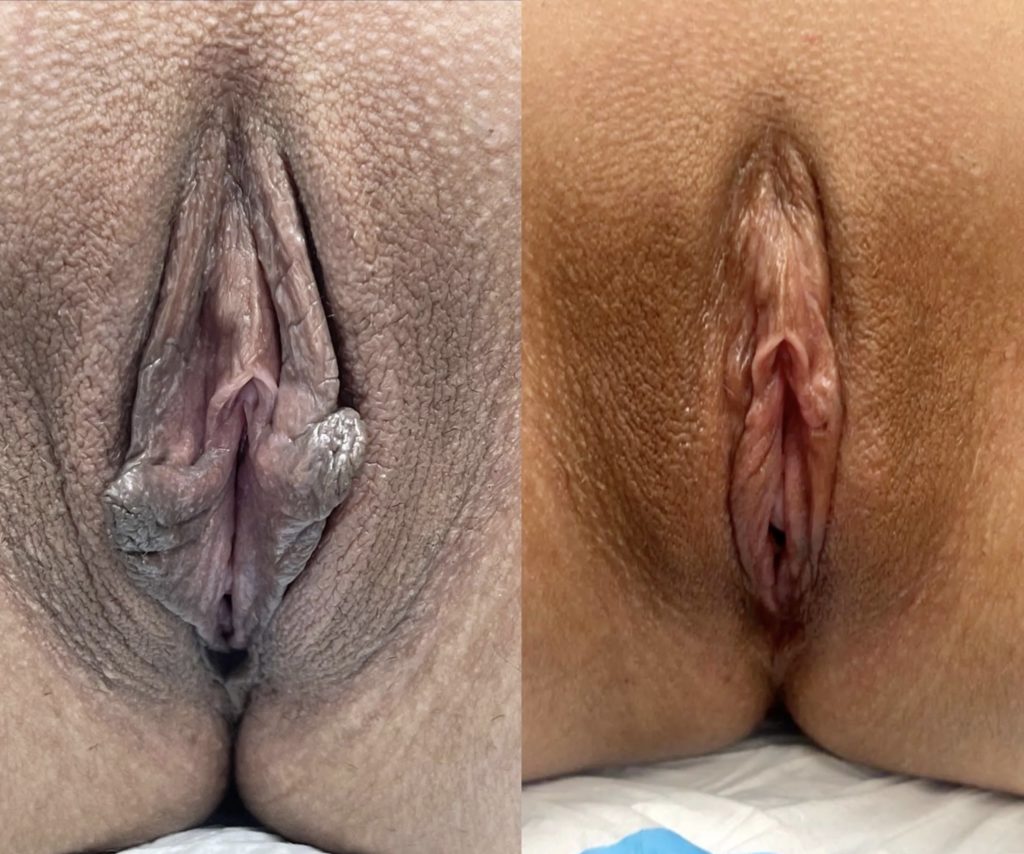
A six-month follow-up with a 33-year-old patient who had a labiaplasty and clitoral hood reduction. Her results show near-invisible scarring and ideal healing — a demonstration of just how well this tissue recovers.
Case Story
Today I had the pleasure of seeing a 33-year-old patient for her six-month labiaplasty follow-up. She had a labia minora reduction and clitoral hood reduction, and the results at this stage are exactly what we hope for — nearly invisible incisions and beautifully healed tissue.
As you can see from her photos and video, there is almost no evidence of any surgery. The labia minora are very similar to the inside of the mouth in both cellular structure and healing behavior — oral and vaginal mucosa are made up of the same cells — which means very quick healing with minimal to no scarring.
Her standing view tells the full story: before surgery there was a small amount of labia minora visible in the midline, but her full outer labia now camouflage the inner labia completely. No exposed labia minora on standing — that is the ideal endpoint for this type of procedure.
Six-month follow-up results
Procedure Highlights
Labia minora reduction
Clitoral hood reduction
Near-invisible incisions at six months
No exposed labia minora on standing — ideal endpoint achieved
Full outer labia camouflaging inner labia naturally
Dramatically thinner, smoother labial profile
What This Follow-Up Demonstrates
Labia Heal Like the Inside of Your Mouth
Oral and vaginal mucosa are made up of the same cells, and they heal in a remarkably similar way — quickly and with very little scarring. At six months, the incisions from a labiaplasty are often barely visible even on close examination.
The Standing View Is the True Measure
The ideal outcome for labiaplasty is no exposed labia minora when standing. This patient’s full outer labia now naturally camouflage the inner labia — the before-and-after standing comparison shows the real functional and aesthetic improvement.
Hood Reduction Completes the Result
Most well-performed labiaplasties include a clitoral hood reduction to maintain balance. Without it, the hood can remain prominent relative to the reduced labia, leaving the overall result looking unfinished. Together, the two procedures create a proportional, natural appearance.
Six-Month Follow-Up Video
Dr. Oppenheimer walks through the six-month healing results, demonstrating near-invisible incisions, the standing-view endpoint, and how labia tissue heals with remarkably little evidence of surgery.
Edited Transcript
All right, we are six months post a labiaplasty with a hood reduction. You can see just how invisible the incisions are, how much thinner the tissues are — really can barely see any evidence of any surgery, and the labia just heal really quite magically.
It’s very similar to the inside of the mouth where there’s very, very little scarring, very, very little evidence of any kind of injury. So that’s labiaplasty and hood reduction. She healed beautifully. We are six months post-op, doing great.
Her standing view was a little more subtle before, but you could see there was a little labia minora exposed in the midline. But she has nice full outer labia that really camouflage the inner labia as well. So really ideal endpoint — no exposed labia minora on standing.
Frequently Asked Questions
How long does it take for labiaplasty to fully heal?
Most patients are largely healed by three weeks. By six weeks there are no activity restrictions. Final results — including complete scar fading — are typically visible by three to six months.
Will labiaplasty leave visible scars?
Scarring from labiaplasty is typically minimal to invisible. The labial tissue heals similarly to the inside of the mouth — the same type of cells — which means very rapid healing with very little evidence of scarring over time.
What is the ideal result for labiaplasty?
The ideal endpoint is no exposed labia minora when standing, with the inner labia naturally camouflaged by the outer labia. The result should look natural and proportional — not overcorrected.
Why is a clitoral hood reduction often done with labiaplasty?
Without a hood reduction, a prominent clitoral hood can remain after labiaplasty, making the result look unbalanced. Performing both procedures together ensures the labia and hood are proportional to each other.
How often do patients come back for follow-up after labiaplasty?
Dr. Oppenheimer typically sees patients once at the three-week post-op mark. Because labia heal so well, a single check-in is usually all that's needed to confirm everything is on track.