Labiaplasty with Hood Reduction and Perineoplasty Under Local Anesthesia
This case features a 27-year-old patient returning to Dr. Oppenheimer after a previous breast augmentation. She underwent a labiaplasty, clitoral hood reduction, and a small perineoplasty — all performed under local anesthesia with oral sedation.
Case Story
Today’s labiaplasty patient is a lovely 27-year-old who has seen us previously for a breast augmentation. I’m very honored to have her come back today to have her labiaplasty performed.
We almost always perform these surgeries under local anesthetic, and today we added an oral sedative — Valium — to that plan. She said the process was quite easy and was less painful than any tattoo she’s had. She only felt the needle poke for the first few seconds of the surgery.
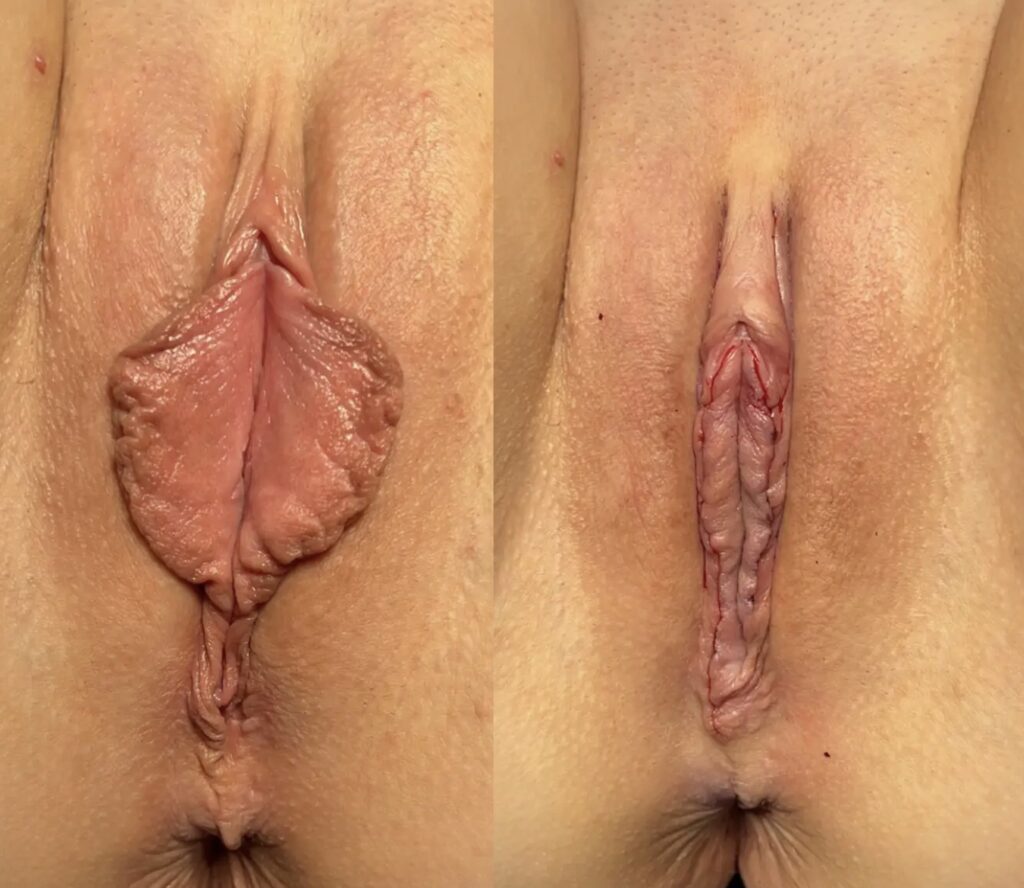
One thing to note with today’s case is that there was some asymmetry of her labia, with the right side extending down toward the perineum. Because of this, her excision patterns differ from right to left, and we also performed a small perineoplasty on that side to achieve a balanced result.
Procedure Highlights
Labia minora reduction
Clitoral hood reduction
Small perineoplasty (right side only)
Performed under local anesthesia with oral sedation (Valium)
Asymmetric excision pattern to address natural anatomy
Dissolving 5-0 Monocryl sutures — no track marks or visible scarring
Procedure duration approximately 1 hour 30–40 minutes
Surgical Philosophy and Teaching Points
The Key Is Not How Much You Take Off, But How Much You Leave
A common misconception about labiaplasty is that the goal is to remove as much tissue as possible. In reality, the labia minora serve an important protective function — shielding the vaginal opening and the urethra. The goal is to remove only what is extra, preserving a thin, natural-looking cuff of tissue.
Asymmetry Is Normal and Shapes the Surgical Plan
Every patient has some degree of natural asymmetry between the left and right labia. In this case, the right side extended further toward the perineum, which required a different excision pattern on that side and the addition of a small perineoplasty. Surgical markings are always customized to the individual anatomy rather than forcing both sides to match a standard shape.
Dissolving Sutures Mean No Visible Scarring
All sutures used in this labiaplasty are 5-0 Monocryl — a sugar-based dissolving thread approximately the thickness of a human hair. There are no sutures to remove, no track marks, and no visible scarring. The sutures dissolve completely within about three weeks.
Surgical Video
This video covers the full labiaplasty procedure including the injection technique, how much bleeding to expect, the suture technique, and a walkthrough of the final result. Dr. Oppenheimer also explains why he performed a small perineoplasty on one side to achieve balance from top to bottom.
Edited Transcript
There’s the labial lips — we’re going to do the same thing on the other side. All right, we are closing this labiaplasty and hood reduction. You can see on this side where the opening is toward the bottom, and we’re just finishing that. You can see how nice and symmetrical things look.
We removed tissue from the hood, from the labia, and then even from the perineum on this side. The vaginal opening ends right here, and we closed all the way down. Everyone has a slightly different shape and size of the labia from right to left. The key is not how much you take off, but how much you leave. You can see there’s a nice little thin cuff of labia. You don’t really want to get rid of all of the labia — just what’s extra — because you need the labia minora to protect the vaginal opening and the urethra.
The suture is a 5-0 Monocryl — a sugar-based dissolving thread about the thickness of a human hair. It dissolves completely in about three weeks. And you can see how nicely everything comes together. There’s really no scar.
All done with this labiaplasty. We did a hood reduction and a small perineal reduction on the right side only, because she had a little extra tissue there. Top, middle, and bottom — all balanced. Hood reduction, labiaplasty, and small perineoplasty. She has a nice outer labia shape, so when she’s standing this should be totally covered.
Overall she did great. This was about an hour and a half to an hour and forty minutes under local anesthesia. She took a Valium beforehand, we sat, had a nice conversation — and that was labiaplasty, hood reduction, and perineoplasty, all under local. So cool.
Frequently Asked Questions
What procedures were performed in this case?
This patient had a labiaplasty (labia minora reduction), a clitoral hood reduction, and a small perineoplasty on the right side to address extra tissue that extended toward the perineum.
What type of anesthesia is used for labiaplasty?
Dr. Oppenheimer performs labiaplasty under local anesthesia. In this case, an oral sedative (Valium) was added. The patient reported it was less painful than getting a tattoo.
What sutures are used and do they need to be removed?
A 5-0 Monocryl suture is used — a sugar-based dissolving thread about the thickness of a human hair. It dissolves completely in approximately three weeks. No suture removal is needed and there are no track marks or visible scarring.
How long does the procedure take?
This procedure took approximately one hour and thirty to forty minutes from start to finish, all under local anesthesia.
Is it normal for the two sides to look different before surgery?
Yes. Natural asymmetry between the left and right labia is completely normal. In this case the right side extended further toward the perineum, which required a different excision pattern on each side. Surgical markings are always customized to the patient's individual anatomy.
What is a perineoplasty?
A perineoplasty is a procedure that reduces or reshapes tissue at the perineum — the area between the vaginal opening and the anus. In this case a small perineoplasty was performed on one side only to achieve a balanced result from top to bottom.